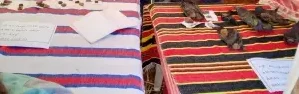
Meo (single)
‘Natsala’ is divided into two, the first is called ‘Hatche Natsala’ and the second is called ‘Kuche Natsala’. Hatche Natsala is slightly higher than Kuche Natsala. It is worn by men. It is worn by men on their shoulders for mourning, reconciliation, festivals and other social occasions. The second is known as Kuche Natsala and is slightly smaller. Kuche Natsala, worn by women, is worn by mothers on their shoulders for various social occasions.

Gabe (Artistic Gabe)
‘Tsibabe Gabe’ as the name suggests, is not a standard pattern of the Gabe, but a special design that is being selected by the weaver. The art of weaving the Gabe and the special design require knowledge and experience and take a long time to complete. In this way, the popularity of the Gabe made with special designs is high. It is a popular handicraft of the Zaise community that is chosen and worn on various social occasions.

Buluko
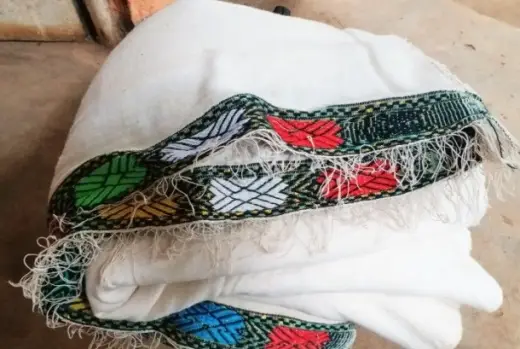
Buluko is one of the most famous traditional costumes of the Zayse ethnic group. It is made using traditional weaving and the main raw material for making Buluko is cotton, especially Habesha cotton. It is embroidered with red at the end. Red embroidery was common in the past because it was easy to find. Therefore, the experts explain that the use of red embroidery in making Buluko has remained a tradition until now. It takes a long time and a lot of effort to make Buluko. A woman who has spun cotton for a long time and made Buluko is famous and has a high reputation. She is also seen as a professional and has a special place in her community and surroundings. In the past, when the Buluko was finished, the woman’s family would slaughter a goat or sheep according to their means.
A bulukko is eight to twelve cubits long and four cubits wide, and is made of cotton, white in color, and finished with a red pattern. The weaver also spends a lot of time and effort on it, so it costs more than a regular gaby. The bulukko, which takes a long time to make, serves various purposes, mainly as a garment. It is worn by fathers on various festivals and social occasions, including weddings. Women also appear prominently on various social occasions, and the dress worn by the bulukko is known as the ‘danche mao’. One of the services provided by the bulukko is to be worn when someone dies.
