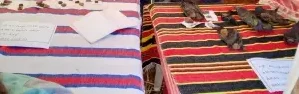
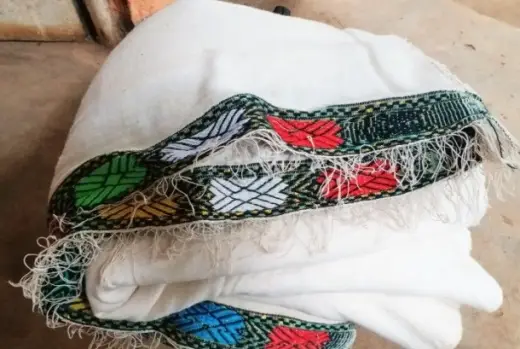
Meo (single) ‘Natsala’ is divided into two, the first is called ‘Hatche Natsala’ and the second is called ‘Kuche Natsala’. Hatche Natsala is slightly higher than Kuche Natsala. It is worn by men. It is worn by men on their shoulders for mourning, reconciliation, festivals and other social occasions. The second is known as Kuche Natsala and is slightly smaller. Kuche Natsala, worn by women, is worn by mothers on their shoulders for various social occasions. Gabe (Artistic Gabe) ‘Tsibabe Gabe’ as the name suggests, is not a standard pattern of the Gabe, but a special design that is being selected by the weaver. The art of weaving the Gabe and the special design require knowledge and experience and take a long time to complete. In this way, the popularity of the Gabe made with special designs is high. It is a popular handicraft of the Zaise community that is chosen and worn on various social occasions. Buluko Buluko is one of the most famous traditional costumes of the Zayse ethnic group. It is made using traditional weaving and the main raw material for making Buluko is cotton, especially Habesha cotton. It is embroidered with red at the end. Red embroidery was common in the past because it was easy to find. Therefore, the experts explain that the use of red embroidery in making Buluko has remained a tradition until now. It takes a long time and a lot of effort to make Buluko. A woman who has spun cotton for a long time and made Buluko is famous and has a high reputation. She is also seen as a professional and has a special place in her community and surroundings. In the past, when the Buluko was finished, the woman’s family would slaughter a goat or sheep according to their means. A bulukko is eight to twelve cubits long and four cubits wide, and is made of cotton, white in color, and finished with a red pattern. The weaver also spends a lot of time and effort on it, so it costs more than a regular gaby. The bulukko, which takes a long time to make, serves various purposes, mainly as a garment. It is worn by fathers on various festivals and social occasions, including weddings. Women also appear prominently on various social occasions, and the dress worn by the bulukko is known as the ‘danche mao’. One of the services provided by the bulukko is to be worn when someone dies.
Zayse Ethnic Clothing
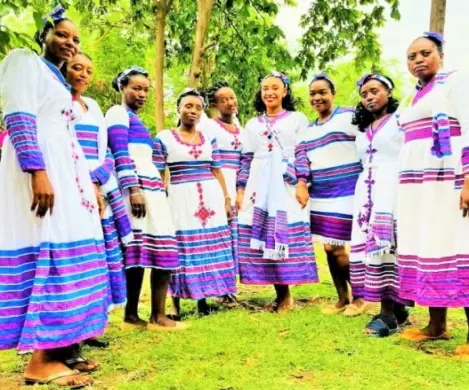
Danche Mao Buluko is a traditional garment called ‘Danche Mao’. Buluko requires a lot of time and effort from artisans. Since it requires a lot of fabric and yarn to make, it is made with extensive preparation. Therefore, the type of garment that is worn with a buluko that takes a lot of effort and is made in this way is called Danche Mao. It is said to be a popular garment worn by Zaise women, especially mothers. The buluko is worn by tying it around the waist and covering it up to the ankles. It is then worn over the waist and is a traditional garment worn for festivals and various social events. Danche Mao got its name because it is tied around the waist with a ‘danche’ /mekenet/. Zaise Pizzo in Modern Design The Zaise Pizzo is currently being used in a modern way by designers. Pizzo is the traditional clothing of the Zaise people and is considered a symbol of the nation. The three colors on the pizzo have their own meanings. The colors are blue, red and white, and the interpretation is as follows. The blue color refers to or represents Chamo Bagade (Chamo Lake), which is a natural resource of the community, which is pure and blue. The red color represents the sacrifices made by the Zaise people to preserve their identity and territorial integrity. The white color represents Zaise as a cotton producer, which is why Zaise is called ‘Zaise Futa Dure’ in neighboring states, and it also represents the peace, unity, and tolerance that all Ethiopians live in. Next, we will look at the clothes made by designers in a modern way. Shinshine (dress) ‘Shinshine’ is a traditional and beloved dress worn by Zaise women, especially a full dress worn by mothers. The sleeves of the shinshine are short or full, and the length usually reaches the ankles. Currently, the shinshine made by Zaise Pizo is popular with both young women and mothers. Designers who work in different designs have been increasing due to consumer demand. The clothes they make are suitable for different events and different weather conditions. Zaise Pizzo, which is made for various occasions including weddings, birthdays, graduations, has become a community value that defines the nation at the national and international levels. In this way, the community is decorating its own artistic heritage that expresses its culture, identity, and history. The role played by the Zaise youth in promoting Pizzo is not easy. Although local government bodies have imposed restrictions on young people wearing Pizzo and entering various cities, they have not succeeded. The role they have played in making the Zaise Pizzo known nationwide by making and wearing it is undeniable. The Zaise Pizzo, which has been growing over time, has become a popular traditional garment beyond Zaise and has become a nationally popular traditional garment. Pizzo is made for young women and men in the form of sweaters and t-shirts. It is made by modern designers and is popular among young people. Young people wear similar /match/ for various programs and events. It is popular among young people in Zayse and is widely worn, being made in various designs. Men’s Full Suit in Pizzo One of the ways we see and understand the Zaisen Pizzo is the men’s full suit. Pizzo is one of the areas where modern designers are making it widely available. It is usually made for formal wear. Representatives of the nation are wearing it at various government meetings, various levels of the House of People’s Representatives and other events. In this way, traditional clothing is a reflection and identity of a community, and it is also a symbol of the nation. Pizzo for children Now, Pizzo, which is being made in a modern way by various designers, is becoming increasingly popular. It is becoming increasingly popular not only among adults but also among children. Thus, when children celebrate their birthdays, they are being made by professionals with special designs. The parents of the children also make them for their birthdays. In such cases, it is encouraged to use our own traditional clothes. It is self-evident. Especially in recent times, Pizzo clothes made in a modern way by designers have become increasingly popular. This should be encouraged and continued. Zaise Warrior Costume In the past, traditional Zaise warriors wore a variety of weapons to defend their community from various attacks. The main ones were swords, spears, shields, daggers, and a lance. The lance is a warrior’s cloak made from various animal skins. It is made from various animal skins, with lion and leopard skins being particularly popular. After completing all of the above, Zaise warriors would drape a lance over their shoulders. The traditional clothing of the Zaise people has gone through various stages of development since ancient times and has reached the level it is today. For the Zaise people, traditional clothing has a role beyond covering the body and protecting them from the cold. It is worn as a dress of honor for weddings, funerals, festivals, and other social events. It has also served as a warrior’s dress on the battlefield. Brides have seen their world with grace and beauty. So, the traditional clothing, which is the result of the artisans of the Zaise community, has been the greatest gift of all gifts to this day. It is given to the deceased family by relatives during mourning, given as a gift by parents when their children are buried, and given as a reward when children graduate from school. It is a cultural value of the community that has been passed down from generation to generation. Traditional clothing is currently being designed in a modern way by designers in various ways, and is being prepared and offered to users of both genders and all ages according to the needs of the user. This is encouraging and encouraging, especially for the youth to know and use their culture and to inform others. The